
 Business License
Blog Categories

From Felt to Synthetic Underlayment in North American Roofing
A roofing supplier in North America once kept both felt and synthetic underlayment on the same rack and watched the split shift within a few seasons. Contractors who had bought felt for years began to specify the synthetic sheet for most jobs, and the felt moved to the repair work where a short length was needed.
The change from felt to synthetic is one of the clearest product transitions in North American roofing, and it did not happen at once. It moved through a series of shifts in material supply, in code requirements and in the practical experience of crews. This article traces the synthetic underlayment trend, what the underlayment market north america looks like today, and what a felt replacement underlayment has to do to be accepted.
1. Synthetic Underlayment Trend and Its Drivers
The synthetic underlayment trend was driven by a set of product failures and by a change in what the roofing industry asked an underlayment to do.
Felt was adequate for a roof that was covered quickly, and it was inexpensive and widely produced. Its limits appeared as buildings grew more complex, as roofs were left exposed for longer periods, and as crews began to value a material that would survive being walked on.
| Driver | Effect on the Trend |
|---|---|
| Felt brittleness | Split at ridges and valleys |
| Tearing at fasteners | Failures during installation |
| Longer exposure periods | Demand for a longer rated period |
| Lighter rolls | One-person handling on site |
| Wider sheets | Faster coverage, lower labour |
The labour argument was as strong as the technical one. A wider, lighter roll covers more roof per hour, and an underlayment that resists tearing reduces the time spent on repairs during the work. On a production roofing schedule those two effects combine.
The trend also moved through the supply chain. As manufacturers converted capacity from felt to synthetic, the felt supply narrowed and its price advantage fell, which pushed more of the market toward the synthetic product. The transition therefore had a commercial driver as well as a technical one.
2. Underlayment Market North America Today
The underlayment market north america now divides between the synthetic sheet in the field and the self-adhering shield at the details, with felt retained in a narrower set of uses.
The synthetic sheet covers the general area of the roof. Its figures are quoted as weight, tensile strength, tear resistance and exposure period, and the grade follows from the slope and the wind exposure.
| Product | Role on the Roof |
|---|---|
| Synthetic underlayment | Field coverage, secondary layer |
| Self-adhering shield | Eaves, valleys, penetrations |
| Felt | Repair work, some legacy uses |
The self-adhering shield has grown alongside the synthetic sheet rather than being displaced by it. The shield is a different product for a different duty, and a North American roof now typically carries both: a synthetic sheet over the field and a shield at the eaves, in the valleys and around the penetrations.
Felt has not disappeared. It remains in repair work where a short length is needed, in some legacy specifications, and in markets where the supply chain still carries it at a lower price. Those uses are narrower than they were, and they are the exceptions rather than the rule, which is why a specification that names felt should be checked against what the market can still supply reliably.
3. What a Felt Replacement Underlayment Has to Do
A felt replacement underlayment has to match the felt on the functions where felt was adequate and improve on it where felt failed.
Felt shed water at the laps, and a replacement has to do the same. The lap direction, the lap width and the fastening pattern at the laps all carry over from the felt practice.
Felt also provided a degree of surface friction that a synthetic sheet does not. A replacement has to compensate, either through a textured or printed surface or through the crew's awareness of the difference.
| Function | Felt | Replacement Requirement |
|---|---|---|
| Water shedding at laps | Adequate | Match |
| Tear at fasteners | Weak | Improve |
| Flexibility over time | Weak | Improve |
| Surface friction | Higher | Compensate |
| Exposure period | Short | Improve |
The functions that a replacement has to improve are the ones that caused the felt failures, and the functions that it has to match are the ones that felt performed adequately. A replacement that matched felt on the tear resistance would not have been worth the change.
The exposure period is the function where the improvement is largest and where the schedule benefit appears. A longer rated exposure gives the roofing programme more room between wrapping the deck and installing the covering, and that is often the reason a contractor switches.
4. Synthetic Underlayment Trend in the Supply Chain
The shape of the change followed the supply chain as much as the product, and the supply chain moved in stages.
The first stage was the introduction of the synthetic sheet alongside felt, with both products available and the contractor choosing per job. The second stage was the widening of the synthetic range, as manufacturers produced grades for different slopes and exposures.
The third stage was the narrowing of felt. As capacity converted, the felt range thinned and the price advantage narrowed, and the choice became less about the product and more about availability.
The fourth stage is the current one, in which the synthetic sheet is the default for the field and the self-adhering shield is the default for the details. The market has settled into that division rather than into a single product for the whole roof.
5. Case Notes on the Felt Replacement Underlayment Shift
A roofing supplier in North America kept both products on the same rack and watched the split shift within a few seasons. The felt moved from the main jobs to the repair work, and the synthetic sheet became the standing stock for new roofs. The change was driven by the crews, who found the lighter and wider rolls faster to install.
A contractor who switched to a synthetic underlayment without changing the fastening pattern found the laps lifting on an exposed slope. The pattern that had been adequate for a felt installation was not adequate for a lighter and wider sheet, and the difference was in the fastening rather than in the material. The contractor then adopted the manufacturer's pattern as a standard for the product.
Both cases show the same point. The transition to a new product carries an installation practice with it, and the practice has to change with the material.
6. Reading the Underlayment Market North America Trend
A buyer reading the synthetic underlayment trend should look at three things: the direction of the supply chain, the direction of the specification, and the installation practice.
The supply chain has moved toward the synthetic sheet, which means the range is widening and the price is converging. A specification that names felt should be checked against what the market can still supply reliably.
The specification has moved toward a synthetic sheet in the field plus a self-adhering shield at the details. That division is stable and it reflects the two different duties.
The installation practice is where the change is still incomplete. A crew that has converted its product without converting its fastening and its lap practice has taken the benefit of the material and left the risk in the detail.
7. Choosing a Felt Replacement Underlayment
Choose a replacement on the functions where felt failed, and check that it matches felt on the functions where felt was adequate.
Confirm the tear resistance and the exposure period, which are the two figures where the improvement matters most and where a specification written around felt does not carry over.
Adopt the manufacturer's fastening pattern and lap width as the site standard, because the pattern from the felt practice is not adequate for a lighter and wider sheet.
Keep the self-adhering shield at the eaves, in the valleys and around the penetrations, and treat it as an addition to the field sheet rather than as an alternative to it.
8. Synthetic Underlayment Supplier Profile
United Perfect Building Materials, part of Jinan United Perfect Building Materials Corporation, produces synthetic roofing underlayment and supplies buyers in North America. The company quotes the weight, tensile strength, tear resistance and exposure period of each grade, which allows a felt replacement underlayment to be selected on the figures where the change matters.
Jinan United Perfect Building Materials holds retained samples by production batch, so a delivered roll can be checked against the reference used at approval. Buyers following the underlayment market north america can confirm the exposure period and the tear resistance in writing, and can order a shield for the details from the same source. United Perfect can also advise on the fastening pattern where a specifier is converting a roof from felt.
9. FAQ About the Shift to Synthetic Underlayment
9.1 Why did the industry move from felt to synthetic?
The move followed from the limits of felt and from a change in what roofs asked of an underlayment. Felt becomes brittle as its asphalt ages and splits at a ridge or a valley, and it tears at a fastener when a crew walks the roof. As roofs were left exposed for longer periods, a longer rated exposure became valuable, and the labour argument reinforced the technical one, because a lighter and wider roll covers more roof per hour. The synthetic underlayment trend therefore had both a technical and a commercial driver.
9.2 Is felt still used in North America?
Yes, in a narrower set of uses. Felt remains in repair work where a short length is needed, in some legacy specifications that have not been updated, and in markets where the supply chain still carries it at a lower price. The supply of felt has narrowed as manufacturers converted capacity to synthetic products, which has reduced its price advantage. The underlayment market north america now divides mainly between a synthetic sheet in the field and a self-adhering shield at the details, with felt as the exception.
9.3 What is the difference in installation?
The sequence is the same and the practice changes in two places. A synthetic sheet is lighter and often wider than the felt it replaces, so each fastener holds a greater area and the uplift load on it is higher, which means the fastening pattern has to come from the manufacturer rather than from the felt practice. The sheet is also slicker underfoot, particularly when damp, so a crew used to felt has to allow for the difference in footing. The lap direction and the lap width carry over from felt.
9.4 Does synthetic last longer than felt?
It retains its properties for longer in the conditions that matter. Felt depends on its asphalt for flexibility, and the asphalt oxidises as it ages, so a felt that is bent or walked on after a number of seasons can split. A synthetic sheet does not rely on an ageing binder in the same way, so it keeps its flexibility and its tear resistance over a longer period. The exposure period under UV is a separate figure and it is stated by the grade rather than assumed from the material.
9.5 What should I watch when switching products?
Watch the fastening pattern and the surface friction, which are the two places where the practice has to change with the material. A pattern copied from felt leaves each fastener holding a greater area on a lighter and wider sheet, and a lap can lift overnight on an exposed slope. The slicker surface also changes the footing, particularly on a steep roof or a damp morning. The lap direction, the lap width and the role of the self-adhering shield at the details carry over unchanged.
Recently Posted
-
QC Checklist for Synthetic Underlayment Before Shipment
November 3, 2026A buyer in North America once received a shipment in which the lengths on the packing list were correct and the rolls at the centr Read More
-
Synthetic Underlayment Slitting Winding and Roll Diameter Control
November 2, 2026A buyer in North America once rejected a container of synthetic underlayment because the rolls at one end had flattened into an ov Read More
-
Synthetic Underlayment for Tropical and Desert Roofing Projects
November 2, 2026Two projects in the same product family can fail for opposite reasons. A tropical roof underlayment in Southeast Asia can be ruine Read More
-
Synthetic Underlayment for Commercial Roofs in Cold and Windy Regions
November 2, 2026A roofing contractor in a cold region of North America once installed a commercial roof underlayment in midwinter and found the la Read More

Contact Us
Recommended Products
-
 Glasswool Blanket With FSK FacingNegotiableMOQ: 100 Rolls
-
Rockwool Blanket With Wire MeshNegotiableMOQ: 100 Rolls
-
Rockwool Blanket With FSK FacingNegotiableMOQ: 100 Rolls
-
CE Certified Glass Wool Insulation, Glasswool Fiberglass, Low Thermal Conductivity, Noise Reduction for Wall, Roof and Industrial EquipmentNegotiableMOQ: 100 Rolls
-
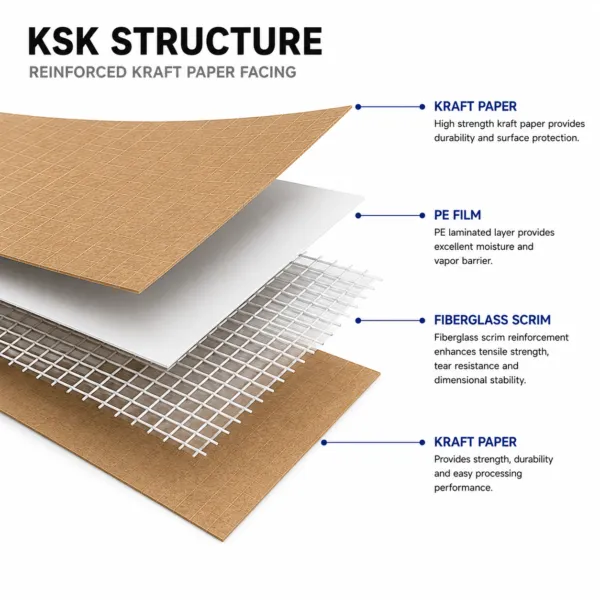
KSK Foil Facing Roll, Laminated Aluminum Foil + Scrim + Kraft Paper, Anti-Tear Thermal Barrier, Suitable for Commercial HVAC and Roof InsulationNegotiableMOQ: 500 Rolls
-
FSK Foil Scrim Kraft, FWF MSK MWV KSK Laminate Foils, Metalized PET MPET Vapor Barrier Facing for Insulation Glasswool RockwoolNegotiableMOQ: 100 Rolls
-
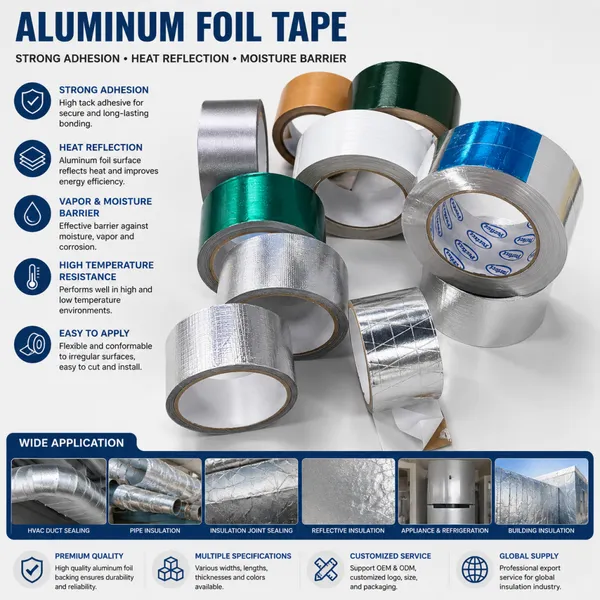
Reinforced Aluminium Foil Tape, Waterproof Anti-aging Tape, Widely Used in HVAC and Building Insulation ProjectsNegotiableMOQ: 500 Cartons
-
HVAC Aluminum Foil Sealing Tape, Strong Adhesion Heat Resistance for Pipe, Glass Wool and Rockwool InsulationNegotiableMOQ: 500 Cartons
-
Factory Supply Metalized PET MPET Laminate Foils, Aluminum Coated PET Film for Roof Wall InsulationNegotiableMOQ: 10000 Cubic Meters
-
Custom MPET Metalized PET Laminate Foils, VMPET Metallized Polyester Facing Film for Thermal InsulationNegotiableMOQ: 10000 Cubic Meters
-
Glass Wool Insulation Series, Glasswool With FSK/FWF/MSK/MWV/KSK Facing, Metalized PET Laminate Foils, Heat & Sound Insulation for Commercial BuildingNegotiableMOQ: 100 Rolls
-
Rockwool Blanket With Black Firber GlassNegotiableMOQ: 100 Rolls
-
Glasswool Insulation Blanket & Board, FSK FWF MSK MWV KSK Foil Laminate, MPET Metalized PET Faced Glass Wool for HVAC, Roof, Wall, Air DuctNegotiableMOQ: 100 Rolls
-
Rockwool Insulation Roll, FSK Foil Faced Mineral Wool for Building Thermal & Acoustic Insulation, Fire Resistant Roof Wall Insulation MaterialNegotiableMOQ: 100 Rolls
-
FWF MSK FSK Foil Laminated Rock Wool Glass Wool Blanket, Metalized PET Laminate Foils Faced Insulation for HVAC and ConstructionNegotiableMOQ: 100 Rolls
-
Rockwool Insulation Board, Mineral Wool Rock Wool Slab for Building Thermal & Fire Insulation, Soundproof Rockwool Panel for Roof, Wall, HVAC SystemNegotiableMOQ: 100 Rolls
-
Rockwool Pipe Section, Mineral Wool Rock Wool Tube Insulation, Fire & Heat Resistant Rockwool for Steam Pipes, Industrial Pipeline Insulation ProjectNegotiableMOQ: 100 Rolls
-
Rockwool Board With FSK FacingNegotiableMOQ: 100 Rolls
-
Rockwool Insulation Slab With FSK Facing, Fireproof Rock Wool Board, Thermal & Sound Insulation Rockwool for Roof, Wall and Ductwork ApplicationNegotiableMOQ: 100 Rolls
-
Fireproof Foil Laminated Glass Wool, Laminate Foils MPET Faced Glasswool Insulation Roll & Sheet for Roofing, Wall, Duct and Pipe InsulationNegotiableMOQ: 100 Rolls