
 Business License
Blog Categories

Aluglass vs FSK Foil Facing for HVAC and Duct Insulation
A mechanical contractor on a hospital project once had to replace the facing on 260 meters of rectangular ductwork before handover. The specification called for an FSK duct insulation facing, and the installer had used it on every run, including the sections that passed through plant rooms where maintenance access required the facing to be cut and re-closed repeatedly. Within weeks the kraft layer had begun to delaminate at the cut edges, and the inspector rejected the installation on appearance grounds alone.
The material that project actually needed was an aluglass duct facing, which tolerates repeated handling at cut edges far better than a kraft-backed foil. Both products do the same basic job. The difference is mechanical, and it decides which of them belongs on a given duct run.
1. What an Aluglass Duct Facing Is Built From
An aluglass duct facing is a laminate of aluminum foil bonded to a fiberglass scrim or fabric. The foil provides the reflective surface and the vapour barrier. The fiberglass provides tensile strength and tear resistance.
Because the reinforcement is glass rather than paper, the facing survives knife cuts, repeated folding at seams and abrasion against duct hangers. That matters in ductwork because ducts are handled many times between fabrication and commissioning, and each handling cycle places a small extra demand on the facing surface.
Surface reflectance is typically around 95 percent at the foil face when new, and emissivity sits below 0.05. Those figures drive the thermal benefit. The reinforcement drives whether that benefit is still present three years later, which is the question a specification should be written around.
2. What an FSK Duct Insulation Facing Is Built From
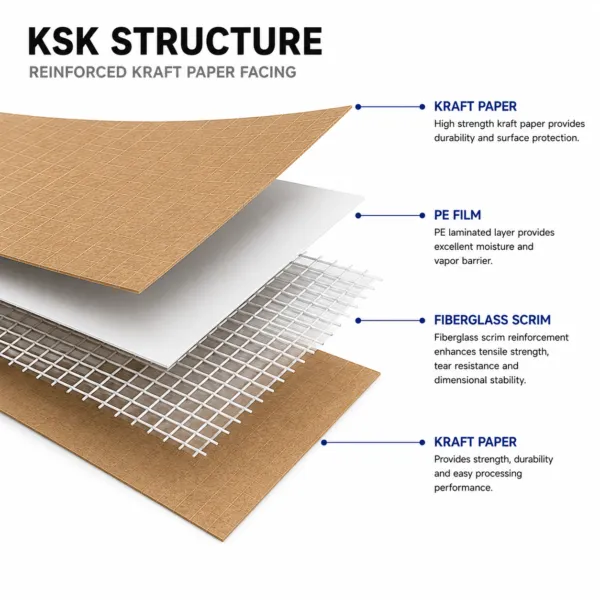
An FSK duct insulation facing is a laminate of aluminum foil, a scrim and kraft paper. The abbreviation stands for foil, scrim and kraft, and the kraft layer provides stiffness together with a printable, paintable outer surface.
The scrim in FSK is a light reinforcement designed mainly to hold the kraft together during handling. It is not intended to carry sustained tensile loads, and it does not stop a tear once one starts at a fastener or a cut edge.
FSK is the conventional choice for duct board facing and for mechanical insulation on equipment, where the facing is applied once and then left alone. Its cost per square meter is lower than an aluglass duct facing because kraft is cheaper than glass fabric. For contractors comparing an hvac duct foil facing across a whole project, that price difference is real but narrow once handling losses are counted.
One further distinction matters on site. FSK accepts printing and labelling directly, which suits equipment insulation where identification matters. Glass-reinforced facings can also be printed, but the surface is less absorbent and the print has to be specified as part of the lamination rather than applied afterwards.
3. Side by Side: How the Two HVAC Duct Foil Facing Grades Differ
The comparison below covers the properties that determine selection on a duct project. Price is deliberately left out of the table, because cost per square meter becomes meaningful after the handling and warranty profile are settled rather than before.
| Property | Aluglass Duct Facing | FSK Duct Insulation Facing |
|---|---|---|
| Reinforcement | Fiberglass scrim or fabric | Light scrim with kraft paper |
| Tensile strength | High, suits tensioned installation | Moderate, suits flat application |
| Tear resistance at cut edges | Holds shape, minimal fraying | Kraft layer can lift and delaminate |
| Surface durability in handling | Withstands repeated contact | Marks and scuffs more easily |
| Water resistance | Glass core is not affected by damp | Kraft can soften if wetted |
| Typical roll width | 1.0 to 1.2 m | 1.0 to 1.2 m |
| Typical application fit | Duct wrap, exposed runs, plant rooms | Duct board facing, protected equipment |
The two columns are not a quality ranking. They describe where each material behaves well, and on most projects both appear in the same specification on different runs. A mechanical contractor who keeps both grades in the van and assigns them run by run generally spends less than one who standardises on a single facing for the whole job.
4. Thermal and Acoustic Performance of Each Aluglass Duct Facing
Thermally, the two facings are close when new. Both present a low-emissivity aluminum surface, and both reduce radiant transfer across the insulation cavity by a similar margin. When a duct is insulated to a specified thickness, the facing choice changes surface heat transfer far less than the insulation thickness does.
Acoustically, the difference sits in the facing rather than in the insulation. A glass-reinforced facing stays taut across a duct run and reflects sound consistently. A kraft-backed facing that has softened or lifted creates a surface with uneven acoustic behaviour, which shows up as variability in measurements along the same run.
The more practical difference appears over time. A facing that has delaminated locally loses part of its vapour resistance at exactly the points where ducts tend to sweat, and condensation damage follows. That failure mode is what pushes engineers from FSK toward an aluglass duct wrap on cooling ducts in humid plant rooms, and it is also what makes the initial price gap misleading.
5. Where Each Facing Belongs on an HVAC Project
The selection rule that works in practice is based on how much the facing will be handled after installation rather than on the duct thermal duty alone. The table below maps common duct situations to the facing that tends to hold up in each.
| Duct Situation | Facing That Fits | Reason |
|---|---|---|
| Exposed ductwork in occupied spaces | Aluglass duct facing | Surface is seen and touched, resists scuffing |
| Plant rooms with maintenance access | Aluglass duct facing | Facings are cut and reopened during service |
| Concealed duct board facing | FSK duct insulation facing | Applied once, then sealed behind ceilings |
| Equipment and appliance insulation | FSK duct insulation facing | Stiff surface, printable for labels |
| Cooling ducts in humid zones | Aluglass duct facing | Holds vapour resistance where moisture condenses |
| Fabricated fittings and offsets | Aluglass duct facing | Cuts clean at every knife line |
Projects that run both materials usually buy the aluglass grade for external and accessible runs and keep FSK for the sections nobody will see again. Mixing the two on one job is normal practice rather than a compromise.
6. Case Notes on Aluglass Duct Facing and FSK Duct Insulation Facing
A duct fabricator in South Asia had been supplying FSK-faced duct board to a hospital contract. The site rejected roughly one in twelve sections at inspection because the kraft surface had lifted at cut edges after the fittings were assembled. The fabricator switched the exposed and accessible runs to an aluglass duct facing while keeping FSK on the concealed sections. Rejection rates on the affected runs dropped to near zero over the remainder of the contract, and total material spend rose by roughly 9 percent because a portion of the order changed grade rather than the whole of it.
A European contractor retrofitting ductwork in a laundry building chose aluglass duct wrap for the cooling runs because the plant room ran at high humidity. The facing has now been in service through several heating and cooling cycles without visible surface breakdown or condensation staining. The same contractor had specified FSK on an earlier phase of the same building and had recorded surface lifting at roughly a dozen fittings within the first year.
Both cases came down to the same question. The buyer described where the duct would be, who would touch it, and how often, and the grade followed from that description rather than from a price comparison.
7. Specification Points for an HVAC Duct Foil Facing
When writing a specification, name the reinforcement rather than the product family. Saying glass-reinforced facing removes the ambiguity that a trade name introduces, and it lets suppliers quote against a describable construction.
State the mesh count where tensile strength matters, and state the adhesion requirement with a test method and an aging condition attached. A peel figure without an aging condition is not comparable across suppliers.
Finally, state the roll width against the actual duct dimensions or the wrapping machine width. A 1.2 metre roll on a 1.3 metre duct face produces an unnecessary seam, and every seam is a place where an hvac duct foil facing can fail. United Perfect Building Materials slits rolls to the requested width for exactly this reason, and confirming the width at order stage removes a common source of site waste.
8. Cost Structure of Aluglass Duct Facing Over Service Life
On material cost alone, FSK duct insulation facing usually wins by 15 to 25 percent per square meter. That gap closes quickly once installation and rework are counted against it.
Where a facing has to be replaced after handover, the labour is far larger than the material delta. Duct access, lifting equipment, insulation removal and re-covering typically cost several times the original facing price per meter of run.
United Perfect Building Materials supplies both constructions and slits them to the requested width, which lets a contractor mix grades across a project without carrying two separate suppliers. Jinan United Perfect Building Materials also produces the same laminate in uncoated and coated versions, so one base roll can serve a duct wrap line and an equipment insulation line at the same time. United Perfect keeps samples of both constructions available so a contractor can cut, fold and peel each grade before committing an order.
9. FAQ About Aluglass Duct Facing and FSK Facing
9.1 Can an aluglass duct facing replace an FSK duct insulation facing directly?
In most duct wrap applications, yes, provided the roll width and the insulation thickness stay the same. The facing change affects mechanical durability and vapour behaviour rather than the thermal calculation, so a project that has already been sized does not need to be recalculated. The exception is duct board, where the stiffer kraft backing in FSK contributes to the board surface rigidity. On those assemblies a direct swap can leave the board feeling softer, and the grade of reinforcement has to be selected accordingly rather than simply substituted.
9.2 Which facing performs better on cooling ducts in humid plant rooms?
The glass-reinforced grade, in most cases. Cooling ducts in humid spaces are prone to surface condensation, and any localised delamination opens a path for moisture to reach the insulation beneath. A fiberglass core does not soften when damp, and a full-surface adhesive bond keeps the foil layer continuous across the duct. Kraft-backed facings can soften at cut edges or lifted areas, which is where condensation damage usually begins on those runs, and the repair cost sits with the contractor rather than the material supplier.
9.3 Does the reinforcement affect the fire performance of an hvac duct foil facing?
The reinforcement is one contributor among several. Reaction to fire depends on the aluminum, the adhesive chemistry and the reinforcement together, and on how the finished assembly behaves rather than on any single layer. Buyers should request the test result for the complete facing construction and confirm that it matches the classification the project specifies. Comparing a glass-reinforced facing with a kraft-backed one on the basis of the reinforcement alone leads to conclusions that the test data may not support.
9.4 What should a buyer ask for when sampling both facing types?
Ask for the same nominal foil thickness in both samples so the comparison isolates the reinforcement. Then request a peel strength figure measured after heat aging for each, and a tensile strength figure in both machine and cross directions. Finally, cut both samples at a 45 degree angle with a utility knife and compare the cut edges. The glass-reinforced sample usually holds a clean line while the kraft-backed sample shows lifting, and that visual difference is the closest field proxy for how each will behave on site.
Recently Posted
-
From Felt to Synthetic Underlayment in North American Roofing
November 3, 2026A roofing supplier in North America once kept both felt and synthetic underlayment on the same rack and watched the split shift wi Read More
-
QC Checklist for Synthetic Underlayment Before Shipment
November 3, 2026A buyer in North America once received a shipment in which the lengths on the packing list were correct and the rolls at the centr Read More
-
Synthetic Underlayment Slitting Winding and Roll Diameter Control
November 2, 2026A buyer in North America once rejected a container of synthetic underlayment because the rolls at one end had flattened into an ov Read More
-
Synthetic Underlayment for Tropical and Desert Roofing Projects
November 2, 2026Two projects in the same product family can fail for opposite reasons. A tropical roof underlayment in Southeast Asia can be ruine Read More

Contact Us
Recommended Products
-
 Glasswool Blanket With FSK FacingNegotiableMOQ: 100 Rolls
-
Rockwool Blanket With Wire MeshNegotiableMOQ: 100 Rolls
-
Rockwool Blanket With FSK FacingNegotiableMOQ: 100 Rolls
-
CE Certified Glass Wool Insulation, Glasswool Fiberglass, Low Thermal Conductivity, Noise Reduction for Wall, Roof and Industrial EquipmentNegotiableMOQ: 100 Rolls
-
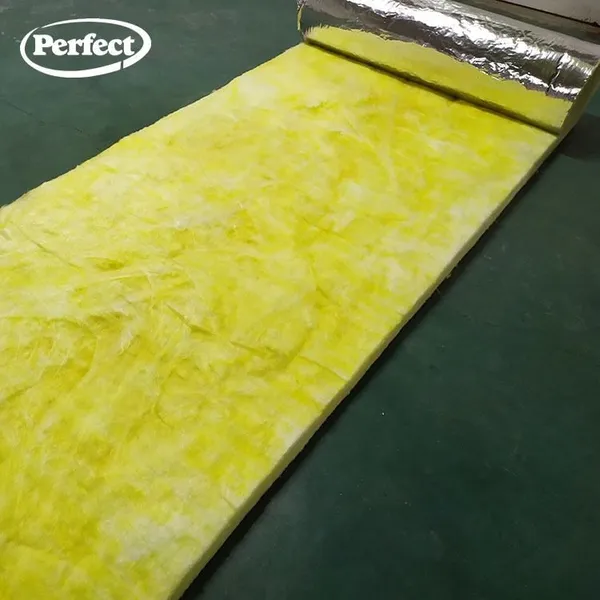
KSK Foil Facing Roll, Laminated Aluminum Foil + Scrim + Kraft Paper, Anti-Tear Thermal Barrier, Suitable for Commercial HVAC and Roof InsulationNegotiableMOQ: 500 Rolls
-
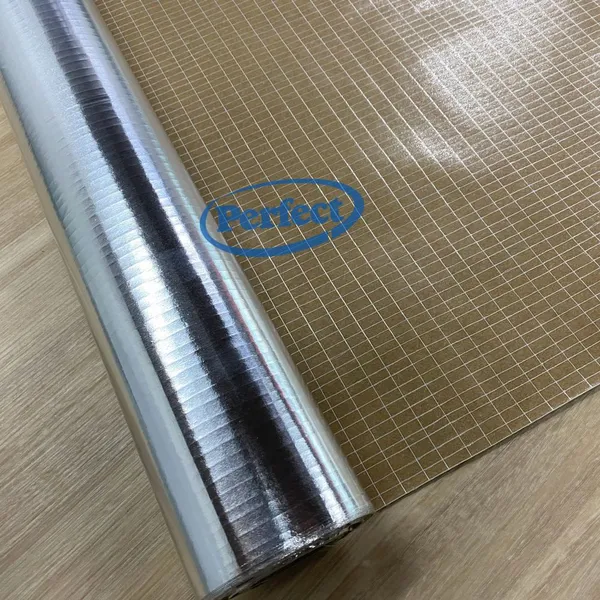
FSK Foil Scrim Kraft, FWF MSK MWV KSK Laminate Foils, Metalized PET MPET Vapor Barrier Facing for Insulation Glasswool RockwoolNegotiableMOQ: 100 Rolls
-
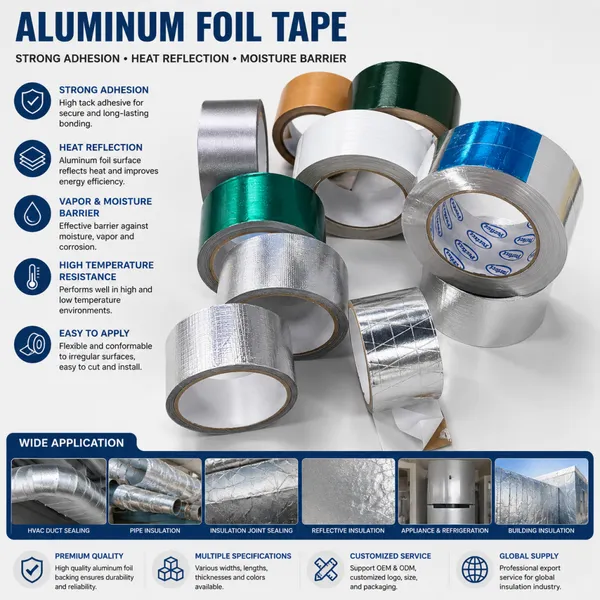
Reinforced Aluminium Foil Tape, Waterproof Anti-aging Tape, Widely Used in HVAC and Building Insulation ProjectsNegotiableMOQ: 500 Cartons
-
HVAC Aluminum Foil Sealing Tape, Strong Adhesion Heat Resistance for Pipe, Glass Wool and Rockwool InsulationNegotiableMOQ: 500 Cartons
-
Factory Supply Metalized PET MPET Laminate Foils, Aluminum Coated PET Film for Roof Wall InsulationNegotiableMOQ: 10000 Cubic Meters
-
Custom MPET Metalized PET Laminate Foils, VMPET Metallized Polyester Facing Film for Thermal InsulationNegotiableMOQ: 10000 Cubic Meters
-
Glass Wool Insulation Series, Glasswool With FSK/FWF/MSK/MWV/KSK Facing, Metalized PET Laminate Foils, Heat & Sound Insulation for Commercial BuildingNegotiableMOQ: 100 Rolls
-
Rockwool Blanket With Black Firber GlassNegotiableMOQ: 100 Rolls
-
Glasswool Insulation Blanket & Board, FSK FWF MSK MWV KSK Foil Laminate, MPET Metalized PET Faced Glass Wool for HVAC, Roof, Wall, Air DuctNegotiableMOQ: 100 Rolls
-
Rockwool Insulation Roll, FSK Foil Faced Mineral Wool for Building Thermal & Acoustic Insulation, Fire Resistant Roof Wall Insulation MaterialNegotiableMOQ: 100 Rolls
-
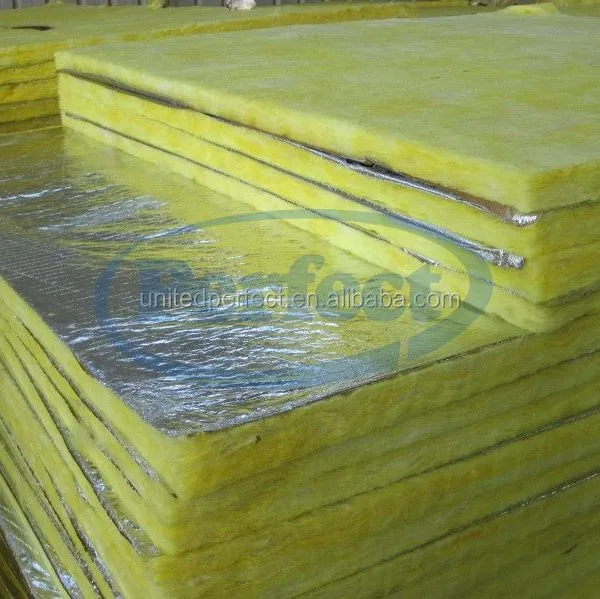
FWF MSK FSK Foil Laminated Rock Wool Glass Wool Blanket, Metalized PET Laminate Foils Faced Insulation for HVAC and ConstructionNegotiableMOQ: 100 Rolls
-
Rockwool Insulation Board, Mineral Wool Rock Wool Slab for Building Thermal & Fire Insulation, Soundproof Rockwool Panel for Roof, Wall, HVAC SystemNegotiableMOQ: 100 Rolls
-
Rockwool Pipe Section, Mineral Wool Rock Wool Tube Insulation, Fire & Heat Resistant Rockwool for Steam Pipes, Industrial Pipeline Insulation ProjectNegotiableMOQ: 100 Rolls
-
Rockwool Board With FSK FacingNegotiableMOQ: 100 Rolls
-
Rockwool Insulation Slab With FSK Facing, Fireproof Rock Wool Board, Thermal & Sound Insulation Rockwool for Roof, Wall and Ductwork ApplicationNegotiableMOQ: 100 Rolls
-
Fireproof Foil Laminated Glass Wool, Laminate Foils MPET Faced Glasswool Insulation Roll & Sheet for Roofing, Wall, Duct and Pipe InsulationNegotiableMOQ: 100 Rolls