
 Business License
Blog Categories

Aluglass Fabric Specifications: Weight Mesh and Tensile Strength
A purchasing manager in Oceania compared two quotations for the same foil facing and found a price difference of 19 percent. Both quotations named the same product family and both quoted the same roll width. The difference was in the reinforcement: one supplier was offering a 2x2 mesh at 75 grams, and the other a 4x4 mesh at 130 grams.
The two products are not the same and the price difference was justified. Aluglass fabric weight, mesh count and tensile strength move together, and a specification that names one figure without the others leaves the material undefined. This article sets out how the three properties relate, what ranges suit which applications, and how to write a specification that a supplier can meet on the first shipment.
1. Aluglass Fabric Weight: What the Figure Describes
Aluglass fabric weight is normally quoted in grams per square metre for the reinforcement alone, or as a total laminate weight that includes the foil and the adhesive.
The distinction matters more than most specifications acknowledge. A reinforcement quoted at 75 grams per square metre describes the glass fabric. A laminate quoted at 130 grams per square metre describes the finished roll, including a foil layer that weighs very little and an adhesive layer that weighs more than the foil.
Comparing the two figures directly is meaningless, and it happens often. A supplier quoting a laminate weight against a competitor quoting a reinforcement weight can appear heavier when the reinforcement is actually lighter.
| Figure Quoted | What It Covers | Typical Range |
|---|---|---|
| Reinforcement weight | Glass fabric alone | 60 to 110 grams per square metre |
| Total laminate weight | Foil, adhesive and fabric | 110 to 200 grams per square metre |
| Foil thickness | Aluminum layer | 7 to 9 micron |
Ask which figure is being quoted before comparing prices. The answer frequently explains a difference that looks like a pricing decision. A quotation that states aluglass fabric weight on the reinforcement basis and a second quotation that states it on the laminate basis can differ by 60 grams per square metre while describing material of identical construction.
2. Aluglass Mesh Count and Its Effect on Performance
Aluglass mesh count describes the number of yarns per inch in each direction, expressed as a two-part figure such as 2x2 or 4x4.
A higher mesh count means more yarns and a denser fabric. Denser fabric resists tearing better and holds its shape under load, and it also weighs more and costs more. A lower mesh count produces a lighter, more flexible material that handles complex shapes more easily. The trade-off appears as tear resistance between yarns, which is where a coarse fabric fails first when it is unsupported, so aluglass mesh count sets the performance floor before any other property is considered.
The mesh count is the single most reliable indicator of how a facing will behave across an open span. A 2x2 mesh on a purlin span of 1.5 metres will deflect and eventually tear. The same 2x2 mesh on a duct wrap that is fully supported by the duct surface will perform without difficulty.
| Mesh Count | Yarns per Inch | Typical Use |
|---|---|---|
| 2x2 | Low density | Concealed duct wrap, appliance insulation |
| 3x3 | Medium density | Wall panels, exposed duct work |
| 4x4 | High density | Roof facing over purlins, insulation blankets |
| 5x5 | Very high density | High wind exposure, heavy span |
3. Aluglass Tensile Strength and How It Is Measured
Aluglass tensile strength describes the load the laminate carries before it fails, and it is normally reported separately for the machine direction and the cross direction.
The machine direction runs along the length of the roll, and the cross direction runs across its width. Glass fabric is usually stronger in the machine direction because the yarns there are continuous, while the cross-direction yarns are woven in and are less direct.
The difference between the two figures is a practical matter. A facing that spans between purlins is loaded across its width, so the cross-direction figure governs. A facing that is tensioned along its length in a wrapping machine is loaded in the machine direction, so that figure governs instead.
Tensile strength is usually quoted as force per unit width, in newtons per 50 millimetres. The test method should be stated, since specimen width and grip separation both affect the result. Aluglass tensile strength reported without the direction and the method is difficult to use in a specification, because two labs can produce figures that differ by a third while testing the same roll.
4. How Weight, Mesh and Tensile Strength Relate
The three properties move together, and a specification that fixes one without the others leaves room for the supplier to trade one against another.
A higher mesh count raises the yarn density and therefore raises the weight for the same yarn. It also raises tensile strength, because more yarns carry the load. Increasing yarn thickness raises weight and tensile strength while leaving the mesh count unchanged.
Two products can therefore have the same weight and different mesh counts, or the same mesh count and different weights. Both are legitimate constructions, and they behave differently in service.
Where a buyer specifies the weight alone, a supplier can meet the weight with a coarser mesh and a heavier yarn, which changes the tear behaviour. Where a buyer specifies the mesh count alone, a supplier can meet it with a lighter yarn and reduce the tensile strength. Specifying all three removes the ambiguity.
5. Matching Aluglass Fabric Weight to the Application
The right weight follows from the support condition and the exposure rather than from a general preference for heavier material.
| Application | Suggested Mesh | Suggested Laminate Weight |
|---|---|---|
| Appliance and equipment insulation | 2x2 | 110 to 130 g per square metre |
| Concealed HVAC duct wrap | 2x2 to 3x3 | 120 to 150 g per square metre |
| Exposed duct work | 3x3 | 140 to 170 g per square metre |
| Metal wall panels | 3x3 to 4x4 | 150 to 180 g per square metre |
| Metal roof facing, 1.5 m span | 4x4 | 170 to 200 g per square metre |
| High wind exposure roof | 4x4 to 5x5 | 180 to 210 g per square metre |
Heavier is not automatically better. A roof-grade laminate used on a duct wrap is harder to cut, harder to form around fittings and more expensive, and it delivers no benefit on a fully supported surface.
6. Case Notes on Aluglass Tensile Strength and Mesh Selection
A contractor in Africa specified a 3x3 mesh facing for a metal roof with purlins at 1.5 metre centres and accepted the supplier's assurance that the grade was suitable. The facing sagged between the purlins within the first season and tore at the pin line during a storm six months later. A sample tested after the failure showed cross-direction tensile strength well below what the span required. A 4x4 grade was installed as the replacement.
A second project in Southeast Asia over-specified in the opposite direction. A 5x5 laminate was purchased for concealed duct wrap on a project with 1,100 fittings, and the installation crew reported that the stiffness slowed forming at every joint. The material performed without defect, but the labour cost rose by roughly 15 percent against an earlier phase that had used a 2x2 grade. The heavier grade delivered no performance benefit on a supported duct.
Both projects selected a grade without reference to the support condition. One paid for a failure and the other paid for a material that the application did not need.
7. Writing an Aluglass Fabric Weight Specification
Name all three figures: mesh count, reinforcement or laminate weight with the basis stated, and tensile strength with the direction and the test method.
State whether the weight refers to the reinforcement or to the finished laminate, and use the same basis throughout the document. Mixing the two bases within one specification is a common source of dispute.
State the foil thickness in microns and the adhesive chemistry. These two figures control the thermal and vapour behaviour rather than the mechanical behaviour, and they belong in the same specification because they are delivered on the same roll.
Where the facing will be tested on receipt, name the test in the purchase order. A specification that names three figures and no test method cannot be enforced when a dispute arises.
8. Where United Perfect Building Materials Corporation Fits
United Perfect Building Materials, part of Jinan United Perfect Building Materials Corporation, produces foil facings across the mesh and weight range set out above. The company quotes aluglass fabric weight on a stated basis and provides aluglass mesh count and aluglass tensile strength on the same datasheet, which lets a buyer compare two grades without reconciling different reporting conventions.
Jinan United Perfect Building Materials holds retained samples by production batch, so a delivered roll can be checked against the reference for weight and construction. Buyers specifying roof and duct facings on the same project can order both grades from one source and receive the datasheets on a consistent basis. United Perfect can also confirm the cross-direction tensile figure in writing where the facing will span an open support.
9. FAQ About Aluglass Fabric Weight and Tensile Strength
9.1 Should I specify weight or mesh count first?
Start from the support condition and the exposure, then choose the mesh count, and use the weight to confirm the construction. Mesh count is the better predictor of performance across an open span, because it describes how many yarns carry the load rather than how much material is present. Weight alone can be met with a coarse mesh and heavy yarn, which changes tear behaviour. Specifying both, plus tensile strength, closes the gap that either figure leaves open, and it gives the supplier a construction to meet rather than a single number to match.
9.2 What tensile strength does a roof facing need?
It depends on the span, the fixing pattern and the wind load at the site, so there is no universal figure. The governing value for a purlin span is usually the cross-direction result, because the facing is loaded across its width. Where the requirement is unclear, ask the supplier for tensile results at the intended support spacing rather than at a general condition. A supplier that can discuss the span and the fixing pattern will usually provide a more useful answer than a general datasheet.
9.3 Can a heavier aluglass fabric weight replace a higher mesh count?
Not directly, because weight and mesh count describe different things, and increasing one without the other changes the material in ways that may not help the application. A heavier yarn on a coarse mesh produces a fabric that is strong in tension but easier to tear between yarns. A finer yarn on a dense mesh produces a fabric that resists tear well at a similar weight. Matching the construction to the failure mode is what determines performance, which is why both figures belong in the specification.
9.4 How do I verify the delivered aluglass mesh count?
Count the yarns over a 25 millimetre length on an offcut and multiply by roughly one, or count over 50 millimetres and halve the result. A magnifier or a low-power lens makes this a two-minute check on a clean offcut. Weighing a known area gives the fabric weight on the same basis as the specification. Both checks can be done at the site gate, and both are far quicker than a laboratory test when a delivery needs to be accepted or queried.
9.5 Does foil thickness affect tensile strength?
Very little, because the foil carries almost none of the mechanical load. Tensile strength comes from the glass reinforcement, and the foil's contribution is limited to surface continuity. Foil thickness affects reflectivity, surface durability during handling and resistance to damage at fixings, which is why it is specified separately. A thicker foil on a light reinforcement produces a facing that looks substantial and still tears at the pin line, which is why the two properties should be assessed independently.
Recently Posted
-
From Felt to Synthetic Underlayment in North American Roofing
November 3, 2026A roofing supplier in North America once kept both felt and synthetic underlayment on the same rack and watched the split shift wi Read More
-
QC Checklist for Synthetic Underlayment Before Shipment
November 3, 2026A buyer in North America once received a shipment in which the lengths on the packing list were correct and the rolls at the centr Read More
-
Synthetic Underlayment Slitting Winding and Roll Diameter Control
November 2, 2026A buyer in North America once rejected a container of synthetic underlayment because the rolls at one end had flattened into an ov Read More
-
Synthetic Underlayment for Tropical and Desert Roofing Projects
November 2, 2026Two projects in the same product family can fail for opposite reasons. A tropical roof underlayment in Southeast Asia can be ruine Read More

Contact Us
Recommended Products
-
 Glasswool Blanket With FSK FacingNegotiableMOQ: 100 Rolls
-
Rockwool Blanket With Wire MeshNegotiableMOQ: 100 Rolls
-
Rockwool Blanket With FSK FacingNegotiableMOQ: 100 Rolls
-
CE Certified Glass Wool Insulation, Glasswool Fiberglass, Low Thermal Conductivity, Noise Reduction for Wall, Roof and Industrial EquipmentNegotiableMOQ: 100 Rolls
-
KSK Foil Facing Roll, Laminated Aluminum Foil + Scrim + Kraft Paper, Anti-Tear Thermal Barrier, Suitable for Commercial HVAC and Roof InsulationNegotiableMOQ: 500 Rolls
-
FSK Foil Scrim Kraft, FWF MSK MWV KSK Laminate Foils, Metalized PET MPET Vapor Barrier Facing for Insulation Glasswool RockwoolNegotiableMOQ: 100 Rolls
-
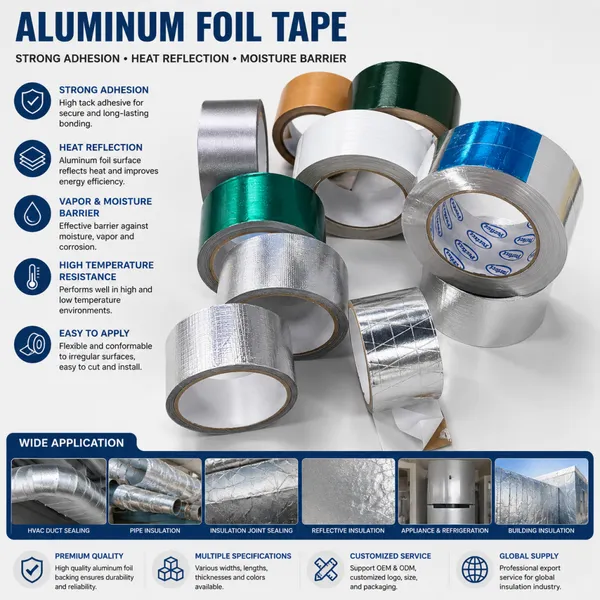
Reinforced Aluminium Foil Tape, Waterproof Anti-aging Tape, Widely Used in HVAC and Building Insulation ProjectsNegotiableMOQ: 500 Cartons
-
HVAC Aluminum Foil Sealing Tape, Strong Adhesion Heat Resistance for Pipe, Glass Wool and Rockwool InsulationNegotiableMOQ: 500 Cartons
-
Factory Supply Metalized PET MPET Laminate Foils, Aluminum Coated PET Film for Roof Wall InsulationNegotiableMOQ: 10000 Cubic Meters
-
Custom MPET Metalized PET Laminate Foils, VMPET Metallized Polyester Facing Film for Thermal InsulationNegotiableMOQ: 10000 Cubic Meters
-
Glass Wool Insulation Series, Glasswool With FSK/FWF/MSK/MWV/KSK Facing, Metalized PET Laminate Foils, Heat & Sound Insulation for Commercial BuildingNegotiableMOQ: 100 Rolls
-
Rockwool Blanket With Black Firber GlassNegotiableMOQ: 100 Rolls
-
Glasswool Insulation Blanket & Board, FSK FWF MSK MWV KSK Foil Laminate, MPET Metalized PET Faced Glass Wool for HVAC, Roof, Wall, Air DuctNegotiableMOQ: 100 Rolls
-
Rockwool Insulation Roll, FSK Foil Faced Mineral Wool for Building Thermal & Acoustic Insulation, Fire Resistant Roof Wall Insulation MaterialNegotiableMOQ: 100 Rolls
-
FWF MSK FSK Foil Laminated Rock Wool Glass Wool Blanket, Metalized PET Laminate Foils Faced Insulation for HVAC and ConstructionNegotiableMOQ: 100 Rolls
-
Rockwool Insulation Board, Mineral Wool Rock Wool Slab for Building Thermal & Fire Insulation, Soundproof Rockwool Panel for Roof, Wall, HVAC SystemNegotiableMOQ: 100 Rolls
-
Rockwool Pipe Section, Mineral Wool Rock Wool Tube Insulation, Fire & Heat Resistant Rockwool for Steam Pipes, Industrial Pipeline Insulation ProjectNegotiableMOQ: 100 Rolls
-
Rockwool Board With FSK FacingNegotiableMOQ: 100 Rolls
-
Rockwool Insulation Slab With FSK Facing, Fireproof Rock Wool Board, Thermal & Sound Insulation Rockwool for Roof, Wall and Ductwork ApplicationNegotiableMOQ: 100 Rolls
-
Fireproof Foil Laminated Glass Wool, Laminate Foils MPET Faced Glasswool Insulation Roll & Sheet for Roofing, Wall, Duct and Pipe InsulationNegotiableMOQ: 100 Rolls