
 Business License
Blog Categories

Breathable Membrane for Wall Systems in Australian and New Zealand Buildings
A builder in Oceania once opened a wall that had been closed for six years and found the framing dry and the membrane intact. The same detail on a neighbouring site, built to the same drawing, had damp framing at the bottom plate. The difference was a missing drip edge above a window, not the membrane.
Australian and New Zealand conditions place a specific set of demands on a wall. High wind-driven rain in coastal areas, intense sun, and a climate that ranges from humid subtropical to cool temperate mean the assembly has to handle both wetting and drying. A breathable membrane wall system in this region is judged on its water resistance and its detailing as much as on its vapour behaviour. This article covers how an australia wall membrane should be specified for these conditions and what the detailing has to achieve.
1. Oceania Building Membrane Conditions in Australian and New Zealand Walls
The region combines a high water load with a high drying potential, and both matter for the assembly in a breathable membrane wall system.
Wind-driven rain is the dominant load in coastal and exposed areas. Rain that is driven horizontally against a wall reaches the cladding at pressure, and a membrane behind the cladding has to resist that water while allowing the wall to dry. This is the load that an oceania building membrane is most often selected against.
Solar exposure is unusually high by European standards. That affects the exterior surfaces and the exposure period of an uncovered membrane on a site. A membrane left exposed through a summer can degrade faster here than in a cooler climate, so the exposure period belongs in the specification alongside the water resistance figure.
| Condition | Demand on the Assembly |
|---|---|
| Wind-driven rain | High water resistance, drained cavity |
| High solar exposure | UV tolerance during construction |
| Humid subtropical north | Drying capability, vapour control |
| Cool temperate south | Condensation control, airtightness |
| Timber framing | Framing moisture tolerance |
Timber framing is used widely across the region, which makes the drying behaviour of the wall more important than it would be with a masonry frame. A timber frame that stays wet for a season loses durability, and the membrane's role is to let it dry rather than to seal it.
2. Wind-Driven Rain and Australia Wall Membrane Selection
Water resistance is the first figure to fix when selecting an australia wall membrane, and it should be matched to the exposure at the site rather than to the building type.
Exposure categories are used in the region to relate the site's wind and rain conditions to a required water resistance. A sheltered suburban site and an exposed coastal site at the same distance from the sea can fall into different categories, and the membrane grade should follow the category.
The cladding type changes the requirement again. A cavity-based cladding drains most of the water that reaches it and leaves the membrane with a reduced load. A directly fixed cladding passes more water to the membrane, which then has to resist it in the plane of the sheet.
Where a wall faces the prevailing weather and the cladding is directly fixed, the combination is the most demanding in the region, and the membrane should be selected for it rather than for the building type.
3. Detailing a Breathable Membrane Wall System
Detailing decides the outcome in this region more than material choice does, because the water load arrives at the openings and the junctions rather than at the middle of the wall.
The head of an opening is the critical detail. Water that reaches the head has to be directed outward and away from the opening, and a drip edge or a flashing at that point does the work. Where it is missing, water tracks back into the frame regardless of the membrane.
The base of the wall is the second detail. Water that collects in the cavity has to drain out, and a clear path at the base with weep openings allows it to leave. A base detail that traps water keeps the bottom plate wet.
Penetrations for services and windows are the third. Each penetration interrupts the membrane, and each needs a sealed detail that maintains both the water resistance and the air tightness. Where the membrane is the air barrier, an unsealed penetration defeats it locally and creates a condensation risk at that point.
4. Oceania Building Membrane Moisture Management by Climate
The region spans a wide climate range, and the moisture strategy changes between the north and the south.
| Climate | Vapour Drive | Assembly Emphasis |
|---|---|---|
| Humid subtropical | Inward for much of the year | Control inward vapour, allow drying |
| Temperate coastal | Reverses seasonally | Tolerant assembly, water resistance |
| Cool temperate | Outward in winter | Internal control, outer permeability |
| Hot dry inland | Outward strongly | Permeable outer layer |
| Alpine or cold upland | Outward, high load | Internal control, low-resistance outer |
In the humid north, the vapour drive is inward for much of the year, which means the assembly should resist inward vapour while still allowing drying outward. A membrane with a low diffusion figure on the outer face supports that.
In the cool south, the drive reverses in winter and the internal control layer does the work. The outer membrane remains permeable so that any moisture that enters can leave. The same membrane grade can serve both, and the difference lies in the internal control layer rather than in the outer membrane.
5. An Oceania Building Membrane and the Airtightness Requirement
An oceania building membrane is increasingly specified for airtightness as well as for water resistance, and the two functions depend on the same joints.
A membrane becomes an air barrier when its laps are taped and its penetrations are sealed. Where that is done, the assembly gains both water resistance and air control, and the heating and cooling demand falls.
Where the laps are not taped, the membrane still sheds some water and no longer provides air control. The change is invisible after the cladding goes on, which is why the jointing detail is worth inspecting before the wall is closed.
The airtightness function also matters for condensation. Air leakage carries far more moisture than diffusion, so an untaped membrane can deliver more moisture into the frame than the same wall with no membrane at all, because the moisture enters at a point where the water resistance and air tightness had been assumed.
6. Case Notes on Breathable Membrane Wall System Performance
A builder in Oceania completed two houses to the same drawing and found damp framing at the bottom plate of one after six years. The other was dry. The difference was a missing flashing above a window on the affected house, which allowed water to reach the base of the cavity without a drain path. The membrane was intact in both houses, and the failure was at the detail rather than the material.
A second project on an exposed coastal site used a membrane with a moderate water resistance figure and a directly fixed cladding. Damp patches appeared on the sheathing after a period of driving rain. The cladding was re-detailed with a cavity and a higher-resistance membrane, and the damp pattern stopped. The two changes addressed different parts of the same problem.
Both cases point to the same conclusion. In this region the membrane is one part of a system, and the detailing around it decides whether it works.
7. Specifying a Breathable Membrane Wall System
State the water resistance against the exposure category for the site rather than against the building type. Two buildings of the same type on different sites do not require the same grade.
State the jointing and the tape, and require the tape to be supplied with the membrane. Where the membrane is the air barrier, the tape is part of the product rather than an accessory.
State the cavity and drainage details, including the base and the opening heads. These are coordination items, and they should appear in the specification so that they are built rather than assumed.
State the exposure period for the uncovered membrane. Solar exposure in the region is high, and a membrane that stays uncovered through a summer may need a grade rated for it.
8. Australia Wall Membrane Supplier Profile
United Perfect Building Materials, part of Jinan United Perfect Building Materials Corporation, produces breathable membranes for wall and roof systems and supplies buyers in Oceania, including Australia and New Zealand. The company quotes water resistance and diffusion resistance on a stated basis, which allows an australia wall membrane to be matched to the exposure category at the site.
Jinan United Perfect Building Materials holds retained samples by production batch, so a delivered roll can be checked against the reference used at approval. Buyers specifying an oceania building membrane for a project that mixes a cavity cladding and a directly fixed section can order the appropriate grades from one source together with the jointing tapes. United Perfect can also confirm the water resistance figure in writing where a wall faces driving rain at an exposed site.
9. FAQ About Breathable Membrane Wall Systems in Oceania
9.1 What water resistance does an australia wall membrane need?
It depends on the exposure at the site and on the cladding, and the two should be assessed together. An exposed coastal wall behind a directly fixed cladding needs a higher figure than a sheltered suburban wall behind a drained cavity. Where the cladding is cavity-based, it sheds most of the water and the membrane handles the remainder; where the cladding is fixed directly, the membrane sees more water in the plane of the sheet. The exposure category and the cladding detail together define the requirement.
9.2 Does the humid northern climate change the membrane choice?
It changes the emphasis rather than the product family. In the humid north the vapour drive is inward for much of the year, so the assembly should resist inward vapour while still allowing drying outward. A membrane with a low diffusion figure on the outer face supports that, and the internal control layer does the rest. The same membrane grade serves the cooler south, where the drive reverses in winter, so the regional difference usually appears in the internal control rather than in the outer membrane.
9.3 How important is detailing compared with membrane grade?
In this region the detailing is usually the more decisive of the two. The water load arrives at the opening heads, the wall bases and the penetrations, and each of those is a detail rather than a field of membrane. A missing drip edge above a window can produce damp framing behind an intact breathable membrane wall system, and a blocked base can trap water at the bottom plate, so a specifier can move an oceania building membrane up one grade and still fail the wall if the base has no drain path. Getting the details right matters more than raising the grade.
9.4 Can a breathable membrane serve as the air barrier?
Yes, where the laps are taped and the penetrations are sealed, and then the membrane provides water resistance and air control at the same time, so the assembly gains thermal performance as well as moisture control. Where the laps are not taped, the membrane sheds some water and delivers no air control, and the change is invisible once the cladding is on. Air leakage carries far more moisture than diffusion does, so an untaped oceania building membrane can deliver more moisture into the frame than a wall with no membrane at all. That is why the jointing detail deserves an inspection before the wall is closed.
9.5 How long can a membrane be left exposed on an Australian site?
It depends on the grade, and the exposure period is stated by the manufacturer. Solar exposure in the region is high, so a membrane left uncovered through a summer degrades faster than it would in a cooler climate, and where a project expects a long gap between wrapping and cladding the exposure requirement should be raised with the supplier before the order rather than assumed. An oceania building membrane rated for a short exposure period may need to be recovered before the cladding goes on, or the grade raised. Exceeding the stated exposure period is a common cause of premature membrane failure.
Recently Posted
-
From Felt to Synthetic Underlayment in North American Roofing
November 3, 2026A roofing supplier in North America once kept both felt and synthetic underlayment on the same rack and watched the split shift wi Read More
-
QC Checklist for Synthetic Underlayment Before Shipment
November 3, 2026A buyer in North America once received a shipment in which the lengths on the packing list were correct and the rolls at the centr Read More
-
Synthetic Underlayment Slitting Winding and Roll Diameter Control
November 2, 2026A buyer in North America once rejected a container of synthetic underlayment because the rolls at one end had flattened into an ov Read More
-
Synthetic Underlayment for Tropical and Desert Roofing Projects
November 2, 2026Two projects in the same product family can fail for opposite reasons. A tropical roof underlayment in Southeast Asia can be ruine Read More

Contact Us
Recommended Products
-
 Glasswool Blanket With FSK FacingNegotiableMOQ: 100 Rolls
-
Rockwool Blanket With Wire MeshNegotiableMOQ: 100 Rolls
-
Rockwool Blanket With FSK FacingNegotiableMOQ: 100 Rolls
-
CE Certified Glass Wool Insulation, Glasswool Fiberglass, Low Thermal Conductivity, Noise Reduction for Wall, Roof and Industrial EquipmentNegotiableMOQ: 100 Rolls
-
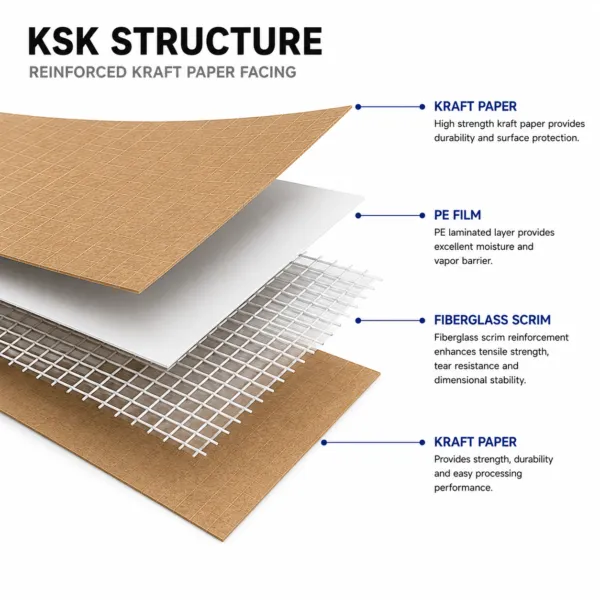
KSK Foil Facing Roll, Laminated Aluminum Foil + Scrim + Kraft Paper, Anti-Tear Thermal Barrier, Suitable for Commercial HVAC and Roof InsulationNegotiableMOQ: 500 Rolls

-
FSK Foil Scrim Kraft, FWF MSK MWV KSK Laminate Foils, Metalized PET MPET Vapor Barrier Facing for Insulation Glasswool RockwoolNegotiableMOQ: 100 Rolls
-
Reinforced Aluminium Foil Tape, Waterproof Anti-aging Tape, Widely Used in HVAC and Building Insulation ProjectsNegotiableMOQ: 500 Cartons
-
HVAC Aluminum Foil Sealing Tape, Strong Adhesion Heat Resistance for Pipe, Glass Wool and Rockwool InsulationNegotiableMOQ: 500 Cartons
-
Factory Supply Metalized PET MPET Laminate Foils, Aluminum Coated PET Film for Roof Wall InsulationNegotiableMOQ: 10000 Cubic Meters
-
Custom MPET Metalized PET Laminate Foils, VMPET Metallized Polyester Facing Film for Thermal InsulationNegotiableMOQ: 10000 Cubic Meters
-
Glass Wool Insulation Series, Glasswool With FSK/FWF/MSK/MWV/KSK Facing, Metalized PET Laminate Foils, Heat & Sound Insulation for Commercial BuildingNegotiableMOQ: 100 Rolls
-
Rockwool Blanket With Black Firber GlassNegotiableMOQ: 100 Rolls
-
Glasswool Insulation Blanket & Board, FSK FWF MSK MWV KSK Foil Laminate, MPET Metalized PET Faced Glass Wool for HVAC, Roof, Wall, Air DuctNegotiableMOQ: 100 Rolls
-
Rockwool Insulation Roll, FSK Foil Faced Mineral Wool for Building Thermal & Acoustic Insulation, Fire Resistant Roof Wall Insulation MaterialNegotiableMOQ: 100 Rolls
-
FWF MSK FSK Foil Laminated Rock Wool Glass Wool Blanket, Metalized PET Laminate Foils Faced Insulation for HVAC and ConstructionNegotiableMOQ: 100 Rolls
-
Rockwool Insulation Board, Mineral Wool Rock Wool Slab for Building Thermal & Fire Insulation, Soundproof Rockwool Panel for Roof, Wall, HVAC SystemNegotiableMOQ: 100 Rolls
-
Rockwool Pipe Section, Mineral Wool Rock Wool Tube Insulation, Fire & Heat Resistant Rockwool for Steam Pipes, Industrial Pipeline Insulation ProjectNegotiableMOQ: 100 Rolls
-
Rockwool Board With FSK FacingNegotiableMOQ: 100 Rolls
-
Rockwool Insulation Slab With FSK Facing, Fireproof Rock Wool Board, Thermal & Sound Insulation Rockwool for Roof, Wall and Ductwork ApplicationNegotiableMOQ: 100 Rolls
-
Fireproof Foil Laminated Glass Wool, Laminate Foils MPET Faced Glasswool Insulation Roll & Sheet for Roofing, Wall, Duct and Pipe InsulationNegotiableMOQ: 100 Rolls