
 Business License
Blog Categories

Synthetic Underlayment GSM Roll Size and Tear Strength
A roofer in the Mid West once complained that a delivered roll felt lighter than the approved sample. It weighed three per cent less, which sounds like nothing until the sheet starts tearing at the eave on the second roof, and three per cent is enough to move a product below the tear threshold the crew relies on.
Synthetic underlayment GSM, roll size and tear strength are the three figures that define the product on paper. This article explains how each is measured, how the three interact, and how to write a purchase order that pins them down so the delivered material matches the approved sample. The final sections cover selection by application and by market.
1. What Synthetic Underlayment GSM Measures
Synthetic underlayment gsm is the mass per unit area in grams per square metre, and it is the quickest single figure for separating one grade from another. A heavier sheet carries more material and generally delivers higher tensile and tear performance, though the relationship is not automatic because the reinforcement type also matters.
The figure is measured on a conditioned sample, and buyers should confirm the conditioning and the sample size when comparing suppliers. A figure quoted on a wet sample or on a small specimen will not match one quoted on a conditioned full-width specimen, and the two are not interchangeable.
Tolerance is where disputes begin. Production varies roll to roll, so a supplier quotes a nominal figure with a tolerance, and a buyer who expects an exact weight will be disappointed. Buyers should agree the tolerance in writing and state the method of verification, usually weighing a roll on arrival and dividing by the nominal area.
2. Underlayment Roll Size and Loading Efficiency
Underlayment roll size covers three dimensions: the width, the length and the core diameter. Width and length set the area per roll and therefore the number of rolls a roof consumes. Core diameter and roll diameter together decide how many rolls fit into a container footprint and height, so the underlayment roll size is a freight decision as well as a coverage decision.
The interaction matters commercially. Two products with the same gsm and the same total area can load differently if their roll diameters differ, and the one that loads more efficiently carries a lower freight cost per square metre. For a bulky rolled product this difference is often larger than the unit price difference between suppliers.
Crews also have a preference. A heavier roll is more tiring to carry up a ladder, and a wider roll covers more area per pass but is harder to control in wind. Buyers should confirm the format with the installers rather than assuming the factory standard is what the market wants.
| Parameter | Typical range | What it affects |
|---|---|---|
| GSM | Light to heavy grades | Cost, tensile and tear performance |
| Roll width | Common metric and imperial widths | Labour per square metre, wind handling |
| Roll length | Set to area per roll | Overlap count, waste at the ridge |
| Core diameter | Small to large core | Roll stiffness, loading density |
| Roll diameter | Follows gsm and length | Container loading quantity |
3. Underlayment Tear Strength and How It Is Tested
Underlayment tear strength describes the force needed to propagate a tear once it has started, and it is tested on a specimen with a prepared cut or nick. The result is reported as a force, often normalised to thickness or to mass per unit area so that products of different weights can be compared.
Underlayment tear strength is the property that governs how a sheet behaves at an eave, at a penetration and under a boot. A sheet with good tensile strength but poor tear strength resists a uniform pull and then fails from a small nick, which is exactly the damage a roofing crew produces. This is why tear strength is the figure to confirm first for a walkable roof.
Reinforcement type changes the tear profile. A woven scrim arrests a tear at the next yarn and usually delivers a higher tear resistance than an unbonded non-woven, while a spunbond non-woven distributes stress differently and can be stronger in tensile. Buyers should state the reinforcement they require rather than comparing gsm alone.
4. How GSM Roll Size and Tear Strength Interact
The three parameters are linked, and a buyer who fixes the gsm and the roll size has largely fixed the tear performance for a given reinforcement. Raising the gsm raises the mass per unit area and usually raises both tensile and tear values, which is why a heavier sheet is the standard answer to a tear complaint.
Underlayment roll size does not change the material performance but it does change the handling. A wider roll reduces the number of overlaps and the labour per square metre, but a wider roll in a light gsm is easier to tear in the wind during installation. Buyers should match the roll width to the crew and the weather, not just to the area calculation.
There is also an economic trade. Moving from a light to a heavy grade raises the material cost and the freight cost in the same step, because a heavier roll loads fewer square metres per container at the same diameter. Buyers should decide whether the extra performance is being used before paying for it.
5. Selecting Synthetic Underlayment GSM by Application and Region
Application sets the minimum gsm. Steep-slope roofs that will be walked during installation need a heavier sheet than a low-slope application covered quickly. Roofs with a long exposure interval before cladding need a sheet that combines a heavier gsm with a verified UV claim.
Region modifies the choice. Buyers in North America tend to specify a heavier sheet than buyers in some other markets, because of the exposure and the wind loads common there. Buyers in Southeast Asia and Central America often prioritise UV and moisture performance because the sheet sits exposed in strong sun and heavy rain.
Desert markets add a different requirement. High surface temperatures and intense UV make the exposure claim the deciding figure, and a buyer in the Mid East should confirm the UV period in writing rather than assuming that a heavier gsm automatically brings a longer exposure window.
6. Writing a Purchase Order for GSM and Underlayment Roll Size
The purchase order should state the gsm with a tolerance, the reinforcement type, the roll width, the roll length, the core diameter and the packing. Every figure that will be checked on arrival belongs in the order, because an oral agreement cannot support a claim.
The verification method should also be stated. Weighing a roll and dividing by the nominal area gives the gsm, and cutting a specimen and measuring it gives the thickness. A buyer who writes the method into the order avoids an argument about whether a variation is real.
The last item is the reference sample. A sealed sample retained by both parties, approved before production, settles any dispute about appearance, colour or hand feel. Buyers should ask the supplier to retain a counterpart sample from the same production run.
7. Quality Checks on Underlayment GSM and Tear Strength
Incoming inspection should be quick and repeatable. Check the roll count and the roll dimensions against the packing list, weigh two rolls from different pallets to confirm the gsm, and inspect the outer wrap for damage and moisture staining. Two rolls is enough to catch a systematic variation.
A simple underlayment tear strength check can be run on site. Cut a specimen, make a small nick at the edge, and pull by hand to see whether the tear runs across the sheet or is arrested by the reinforcement. The check is not a substitute for a laboratory underlayment tear strength value, but it catches a product whose reinforcement has been changed.
The results should be recorded against the batch and kept. A buyer who logs the gsm and the tear behaviour of each shipment builds a record that shows whether a supplier is drifting, and drift is easier to correct before a season of callbacks than after one.
8. Synthetic Underlayment Supplier Profile
Jinan United Perfect Building Materials Corporation produces synthetic underlayments in a range of weights and roll formats, alongside foil laminates, breathable membranes and laminated foil facings. The company was established in 2017 and serves North America, South America, Eastern Europe, Southeast Asia, Africa, Oceania, the Mid East, Eastern Asia, Western Europe, Central America, Northern Europe and Southern Europe.
Jinan United Perfect Building Materials states synthetic underlayment gsm with a tolerance on the purchase order, confirms the underlayment roll size and the loading plan for the container, and supplies test data covering underlayment tear strength. The company provides production samples so a buyer can verify the weight and the reinforcement before ordering.
Buyers sending a specification enquiry to United Perfect should include the application, the target gsm, the reinforcement type, the roll format and the destination port. United Perfect replies with a matched product proposal and the container loading plan.
9. FAQ About GSM Roll Size and Tear Strength
9.1 What gsm should I specify for a roofing underlayment?
The gsm should follow the exposure the sheet will see and the way the roof will be worked, since a walked steep-slope roof demands more material than a quick low-slope cover. Buyers should state the target weight in the unit their crews recognise and write it into the purchase order with a tolerance. A heavier sheet raises both material and freight cost because fewer square metres load per container at the same roll diameter, so the supplier should confirm the test method behind the weight claim. Reinforcement type matters as much as weight, so a lighter woven product can outperform a heavier unbonded non-woven on tear, and the right figure is the lowest weight that survives the installation.
9.2 How do I check the gsm of a delivered roll?
Weigh a roll and divide the mass by the nominal area of that roll, and compare the result with the figure and tolerance stated on the purchase order. Sample two rolls from different pallets rather than one, because a single roll can be atypical and two rolls reveal a systematic variation. Condition the roll to ambient temperature first if it has been stored in a cold container, and record the measured figure against the batch number so drift is visible over several shipments. A variation inside the agreed tolerance is normal and not a defect, while a variation outside the tolerance is a claim that the written weighing method makes straightforward.
9.3 Why does tear strength matter more than tensile strength?
Tear strength governs how a sheet behaves once damage has started, which is the condition a roofing crew creates with every boot edge and penetration. A sheet with good tensile strength can still fail quickly from a small nick if its tear resistance is low, and that failure appears as a split running across the roof, so both figures belong in a specification. Buyers should confirm that suppliers use the same test method before comparing values, since reinforcement type changes the balance between the two and a woven scrim usually improves tear resistance. Tear strength is the figure to confirm first on a walkable roof.
9.4 How does roll size affect the container loading quantity?
Roll size affects loading through the roll diameter and the core diameter, which together decide how many rolls stand in the container footprint and how they stack. Two products with the same total area can load differently if their diameters differ. Buyers should request the loading plan in rolls, the roll dimensions and the net weight per container for each quotation, since those figures let a buyer convert a unit price into a delivered cost per square metre, and for a bulky rolled product the freight share is large enough that loading efficiency can outweigh a unit price difference. Roll width should also match crew practice, since a non-standard width adds labour on the roof and no container loading gain makes up for it.
9.5 Should the roll width match the crew or the factory standard?
The roll width should match the crew, because a non-standard width changes the overlap count and the labour on every roof, and that cost is invisible in the invoice. Buyers should confirm the width and the length their installers normally use and write both into the purchase order. A wider roll covers more area per pass but is harder to control in wind, so the right width depends on the site conditions rather than on the area calculation alone, and a heavier or wider roll than the crews expect also slows the work and can lead to complaints, so buyers should fix the format before the first container and keep it stable across orders. Consistency in roll size is worth more than a marginal price advantage.
Recently Posted
-
From Felt to Synthetic Underlayment in North American Roofing
November 3, 2026A roofing supplier in North America once kept both felt and synthetic underlayment on the same rack and watched the split shift wi Read More
-
QC Checklist for Synthetic Underlayment Before Shipment
November 3, 2026A buyer in North America once received a shipment in which the lengths on the packing list were correct and the rolls at the centr Read More
-
Synthetic Underlayment Slitting Winding and Roll Diameter Control
November 2, 2026A buyer in North America once rejected a container of synthetic underlayment because the rolls at one end had flattened into an ov Read More
-
Synthetic Underlayment for Tropical and Desert Roofing Projects
November 2, 2026Two projects in the same product family can fail for opposite reasons. A tropical roof underlayment in Southeast Asia can be ruine Read More

Contact Us
Recommended Products
-
 Glasswool Blanket With FSK FacingNegotiableMOQ: 100 Rolls
-
Rockwool Blanket With Wire MeshNegotiableMOQ: 100 Rolls
-
Rockwool Blanket With FSK FacingNegotiableMOQ: 100 Rolls
-
CE Certified Glass Wool Insulation, Glasswool Fiberglass, Low Thermal Conductivity, Noise Reduction for Wall, Roof and Industrial EquipmentNegotiableMOQ: 100 Rolls
-
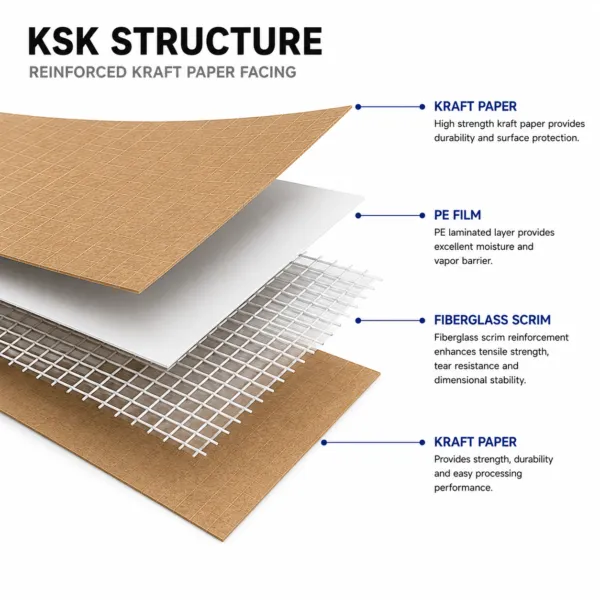
KSK Foil Facing Roll, Laminated Aluminum Foil + Scrim + Kraft Paper, Anti-Tear Thermal Barrier, Suitable for Commercial HVAC and Roof InsulationNegotiableMOQ: 500 Rolls
-
FSK Foil Scrim Kraft, FWF MSK MWV KSK Laminate Foils, Metalized PET MPET Vapor Barrier Facing for Insulation Glasswool RockwoolNegotiableMOQ: 100 Rolls
-
Reinforced Aluminium Foil Tape, Waterproof Anti-aging Tape, Widely Used in HVAC and Building Insulation ProjectsNegotiableMOQ: 500 Cartons
-
HVAC Aluminum Foil Sealing Tape, Strong Adhesion Heat Resistance for Pipe, Glass Wool and Rockwool InsulationNegotiableMOQ: 500 Cartons
-
Factory Supply Metalized PET MPET Laminate Foils, Aluminum Coated PET Film for Roof Wall InsulationNegotiableMOQ: 10000 Cubic Meters
-
Custom MPET Metalized PET Laminate Foils, VMPET Metallized Polyester Facing Film for Thermal InsulationNegotiableMOQ: 10000 Cubic Meters
-
Glass Wool Insulation Series, Glasswool With FSK/FWF/MSK/MWV/KSK Facing, Metalized PET Laminate Foils, Heat & Sound Insulation for Commercial BuildingNegotiableMOQ: 100 Rolls
-
Rockwool Blanket With Black Firber GlassNegotiableMOQ: 100 Rolls
-
Glasswool Insulation Blanket & Board, FSK FWF MSK MWV KSK Foil Laminate, MPET Metalized PET Faced Glass Wool for HVAC, Roof, Wall, Air DuctNegotiableMOQ: 100 Rolls
-
Rockwool Insulation Roll, FSK Foil Faced Mineral Wool for Building Thermal & Acoustic Insulation, Fire Resistant Roof Wall Insulation MaterialNegotiableMOQ: 100 Rolls
-
FWF MSK FSK Foil Laminated Rock Wool Glass Wool Blanket, Metalized PET Laminate Foils Faced Insulation for HVAC and ConstructionNegotiableMOQ: 100 Rolls
-
Rockwool Insulation Board, Mineral Wool Rock Wool Slab for Building Thermal & Fire Insulation, Soundproof Rockwool Panel for Roof, Wall, HVAC SystemNegotiableMOQ: 100 Rolls
-
Rockwool Pipe Section, Mineral Wool Rock Wool Tube Insulation, Fire & Heat Resistant Rockwool for Steam Pipes, Industrial Pipeline Insulation ProjectNegotiableMOQ: 100 Rolls
-
Rockwool Board With FSK FacingNegotiableMOQ: 100 Rolls
-
Rockwool Insulation Slab With FSK Facing, Fireproof Rock Wool Board, Thermal & Sound Insulation Rockwool for Roof, Wall and Ductwork ApplicationNegotiableMOQ: 100 Rolls
-
Fireproof Foil Laminated Glass Wool, Laminate Foils MPET Faced Glasswool Insulation Roll & Sheet for Roofing, Wall, Duct and Pipe InsulationNegotiableMOQ: 100 Rolls